

M1 Garand, Springfield Armory
Data
|
Make: Garand M-1 |
Model: Garand M-1 |
|
Arsenal: Springfield Armory |
Serial #: 2680642 |
|
Caliber: .30-06 |
Date of Manufacturer: |
|
Action: |
Capacity: |
|
Barrel Length: |
Overall Length: |
|
Other Numbers:6528287-SA; C46025W.R.A |
Import Mark?: None |
| Weight: |
Information
Purchased this from a pawn shop in Albuquerque, NM for a good price. All parts are Springfield Armory with the exception of the trigger guard which is W.R.A. (Winchester Repeating Arms). The serial number indicates it was manufactured in February of 1944. The barrel stamp indicates it was re-barreled in October of 1951. I have found no cartouches on the stock.
Close Up Views


Visible Numbers and Markings


History
M1 Garand rifle
From Wikipedia, the free
encyclopedia
The M1 Garand (more formally the United States Rifle, Caliber .30, M1) was the
first semi-automatic rifle in the world to be generally issued to infantry. It
officially replaced the Springfield M1903 rifle as the standard service rifle of
the United States military in 1936, and was in turn officially replaced by the
M14 in 1957. However, the M1 continued to be issued in large numbers until 1963,
and to a lesser degree until 1966.
The M1 was used heavily in World War II, the Korean War, and, to a limited
extent, in the Vietnam War. Most M1 rifles were issued to American troops,
though many were lent to other nations. It is still used by various drill teams
and is a popular civilian firearm. According to experts on the weapon, the
latter version is preferred.
History
Though the U.S. Army became interested in self-loading rifles with the Bang and
Murphy-Manning of 1911, and there were trials in 1916-8, the M1's origin
properly dates to 1919, when armies around the world were realizing standard
rifle cartridges were more powerful than necessary for typical engagement
ranges, leading to heavier weapons than really required. The Army trials in the
1920s had a .256in minimum caliber requirement, compared to the .30-'06 then
standard.
Firearms designer John C. Garand, working at the Army's Springfield Armory,
began with a .30 caliber primer-operated breech. Twenty-four rifles, identified
as "M1922", were built at Springfield in summer 1924, and at Fort Benning during
the summer of 1925 they were tested against the Thompson auto loading rifle,
Berthier, Hatcher-Bang, and "highly promising delayed blowback Pedersen rifle".
This led to a further trial of the improved "M1924" Garand against the Thompson,
ultimately producing an inconclusive report. Therefore, the Ordnance Board
ordered a Garand variant .30-'06, while in March 1927 the Cavalry Board reported
trials between the Thompson, Garand, and '03 Springfield had not led to a clear
winner, leading to a gas-operated .276 model.
During the spring of 1928, both Infantry and Cavalry Boards ran trials with the
.276 Pedersen T1 rifle, giving it high praise (despite its use of waxed
ammunition). On 13 August 1928, a Semiautomatic Rifle Board carried out joint
Army, Navy, and Marine Corps trials between the .30 Thompson, both cavalry and
infantry versions of the T1 Pedersen, "M1924" Garand, and .256 Bang, and on 21
September came back with no clear winner. The .30 Garand, however, was dropped
in favor of the .276.
Further tests by the SRB in
July 1929, which included Brauning, Colt-Browning, Garand, Holek, Pedersen,
Rhinemetall, Thompson, and an incomplete White, led to a recommendation work on
the (dropped) .30 gas-operated Garand be resumed, and a T1E1 was ordered 14
November 1929.
Twenty gas-operated .276 T3E2s Garand's were made and competed with T1 Pedersen
rifles in Spring 1931. The .276 Garand was the clear winner of these trials. The
.30 caliber Garand was tested at these trials in the form of a single T1E1
prototype but was withdrawn with a cracked bolt on 9 October 1931. A 4 January
1932 meeting recommended adoption of the .276 caliber and production of
approximately 125 T3E2s. Meanwhile, Garand redesigned his bolt and his improved
T1E2 rifle was retested. The day after the successful conclusion of this test,
Army Chief of Staff General Douglas MacArthur personally disapproved any caliber
change, in part because there were extensive stocks of .30 ammunition. On 25
February 1932, Adjutant General John B. Shuman, speaking for the Secretary of
War, ordered work on the weapons and ammunition in .276 caliber cease
immediately and completely and all resources be directed toward identification
and correction of deficiencies in the Garand .30 caliber. The Garand worked in
.30 caliber and MacArthur wanted it.
On 3 August 1933, the T1E2 became the Semi-Automatic Rifle, Caliber 30, M1. In
May 1934, 75 M1s went to field trials; 50 were to infantry, 25 to cavalry units.
Numerous problems were reported, forcing the rifle to be modified, yet again,
before it could be recommended for service and cleared for procurement on 7
November 1935, then standardized 9 January 1936. The first production model was
successfully proof-fired, function-fired, and fired for accuracy on July 21,
1937.
Production difficulties delayed deliveries until September 1937. Springfield
reached an output of 100 per day early in September 1939. Despite its production
status, design issues were not at an end. The barrel and gas cylinder assembly
were redesigned and entered production in early 1940. The problem proved so
thorny, even the Johnson had to be deferred so Springfield could concentrate on
the problematic Garand. Production ramped up in 1940, reaching 600 a day by 10
January 1941, and the Army was fully equipped by 1941.
Following the outbreak of World War II in Europe, Winchester was awarded an
"educational" production contract for 65000 rifles, with deliveries beginning in
1943. The British Army tested the M1 Garand as a possible replacement for its
bolt-action Lee-Enfield
No.1 Mk III, but rejected it
after trials to simulate combat conditions.
The M1's semiautomatic operation gave United States forces a significant
advantage in firepower and shot-to-shot response time over individual enemy
infantrymen in battle (German and Japanese soldiers were usually armed with
bolt-action rifles). The impact of faster-firing infantry small arms in general
soon stimulated both Allied and Axis forces to greatly augment issue of semi-
and fully-automatic weapons then in production, as well as to develop new types
of infantry firearms.

John Garand presents his rifle to Army officials.
The Garand remains popular
among civilian weapons collectors and enthusiasts all over the world. General
George S. Patton acknowledged the rifle's prowess when he called it, "the
greatest implement of battle ever devised."
Much of the M1 inventory in the post-WWII period underwent arsenal repair or
rebuilding. While U.S. forces were still engaged in the Korean War, the
Department of Defense determined a need for additional production of the Garand,
and two new contracts were awarded. During 1953-56, M1s were produced by
International Harvester and Harrington & Richardson. Beretta also produced
Garands using Winchester tooling. Most recently, the M1 was produced by
Springfield Armory, Inc. of Geneseo, Illinois. This civilian variant is offered
in either .30-06 Springfield or .308 Winchester chambering.
The M1 proved an excellent
rifle throughout its service in World War II and the Korean War. The Japanese
even developed a copy for their own use near the end of World War II, but it
never reached production. Surplus M1 rifles also armed many nations of the free
world in World War II and postwar, including Germany, Italy and Japan. Some
Garand's were still being used in the Vietnam War in 1963; despite the M14's
official adoption in 1957, it was not until 1965 the changeover from the M1
Garand was completed in the active-duty component of the Army (with the
exception of the sniper variants, which were introduced in WWII and saw action
in Korea and Vietnam). In other components of the armed forces, such as the Army
Reserve, Army National Guard and the Navy, Garand's continued to serve into the
1970s or longer. For example, photos of Ohio Army National Guard troops at the
Kent State shootings in May 1970 clearly show Garand's.
Some military drill teams still use the M1, including the U.S. Marine Corps
Silent Drill Team, the Norwegian Royal Guards Drill Team, and almost all Reserve
Officer Training Corps (ROTC) teams of all branches. Modern Drill Team M1s are
permanently disabled by having a metal rod welded into the barrel. Exhibition
teams often use fiberglass stocks In place of wooden ones, the latter being
heavier and more prone to breakage when dropped.
Design and mechanics

The M1 Garand with important parts labeled.
The M1 rifle is a gas-operated, semi-automatic, clip-fed rifle. By modern
standards, the M1's feeding system is archaic, relying on clips to feed
ammunition, and is the principal source of criticism of the Garand rifle.
Officials in Army Ordnance circles demanded a fixed, non-protruding magazine for
the new service rifle. At the time, it was believed that a detachable magazine
on a general-issue service rifle would be easily lost by U.S. soldiers (a
criticism made of British soldiers and the Lee-Enfield 50 years previously),
would render the weapon too susceptible to clogging from dirt and debris (a
belief that proved unfounded with the adoption of the M1 Carbine), and that a
protruding magazine would complicate existing manual-of-arms drills. As a
result, inventor John Pedersen developed an "en bloc" clip system that allowed
ammunition to be inserted from above, clip included, into the fixed magazine.
While this design provided the requisite flush-mount magazine, the clip system
increased the rifle's weight, and prevented it from being fired without a clip,
such as while reloading.

Two of Garand's patents, showing the original gas trap design and revised gas port system.
Garand's rifle was originally
chambered for the .276 Pedersen cartridge, charged by means of 10-round clips.
Later, it was chambered for the then-standard .30-06 Springfield. With this new
cartridge, the Garand had a maximum effective range of 500 yards (457 m), with
the capability of inflicting a casualty with armor-piercing ammunition well
beyond 880 yards (approx. 800 m). Because of the larger diameter of the .30-06
cartridge, the reworked magazine design held only eight rounds instead of ten.
Garand's original design for the M1 used a complicated gas system involving a
special muzzle extension gas trap, later dropped in favor of a simpler drilled
gas port. Because most of the older rifles were retrofitted, pre-1939 gas-trap
M1 Garands are very rare today and are prized collector's items. In both
systems, expanding gases from a fired cartridge are diverted into the gas
cylinder. Here, the gases met a long-stroke piston attached to the operating
rod. The operating rod was therefore pushed rearward by the force of this
high-pressure gas. Then, the operating rod engaged a rotating bolt inside the
receiver. The bolt was attached to the receiver via two locking lugs, which
rotated, unlocked, and initiated the firing cycle when the rifle was discharged.
The operating rod (and subsequently the bolt) then returned to its original
position.
Features
The weight of the M1 varies between 9.5 lb (4.31 kg) and 10.2 lb (4.63 kg)
unloaded (depending on sling type and stock wood density), a considerable
increase over the previous M1903 Springfield. The length was 43.6 inches (1,107
mm). The rifle is fed by an "en bloc" clip which holds eight rounds of .30-06
Springfield ammunition. When the last cartridge is fired, the rifle ejects the
clip and locks the bolt open. Clips can also be manually ejected at any time.
The "en-bloc" clip is manually ejected by pulling the operating rod all the way
to the rear, and then depressing the clip catch button. Much criticized in
modern times, the en-bloc clip was an innovation for its time. The concept of a
disposable box magazine had not been embraced and en-bloc clips were cheap and
reliable. It was even harder and slower to reload the M1903 rifle. Modern
arguments ignore that the only contemporary rifles with the ability to easily
top-off a magazine were the Johnson M1941 and the obsolete Krag-Jørgensen.
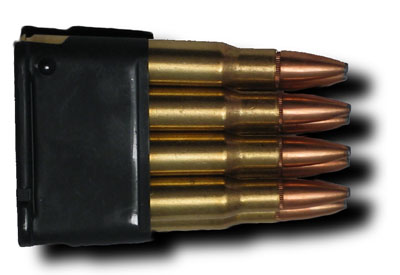
An M1 Garand en bloc clip loaded with eight .30 caliber rounds.
The rifle's ability to rapidly fire powerful .30-06 rifle ammunition also proved
to be of considerable advantage in combat. In China, Japanese banzai charges had
previously met with frequent success against poorly-trained Chinese soldiers
armed with bolt-action rifles. However, armed with the Garand, U.S. Infantrymen
were able to sustain a much higher rate of fire than their Chinese counterparts.
In the short-range jungle fighting, where opposing forces sometimes met each
other in column formation on a narrow path, the penetration of the powerful
.30-06 M2 cartridge enabled a single U.S. infantryman to kill up to three
Japanese soldiers with a single round.
The weight of the M1 varies between 9.5 lb (4.31 kg) and 10.2 lb (4.63 kg)
unloaded (depending on sling type and stock wood density), a considerable
increase over the previous M1903 Springfield. The length was 43.6 inches (1,107
mm). The rifle is fed by an "en bloc" clip which holds eight rounds of .30-06
Springfield ammunition. When the last cartridge is fired, the rifle ejects the
clip and locks the bolt open. Clips can also be manually ejected at any time.
The "en-bloc" clip is manually ejected by pulling the operating rod all the way
to the rear, and then depressing the clip catch button. Much criticized in
modern times, the en-bloc clip was an innovation for its time. The concept of a
disposable box magazine had not been embraced and en-bloc clips were cheap and
reliable. It was even harder and slower to reload the M1903 rifle. Modern
arguments ignore that the only contemporary rifles with the ability to easily
top-off a magazine were the Johnson M1941 and the obsolete Krag-Jørgensen.
The rifle's ability to rapidly fire powerful .30-06 rifle ammunition also proved
to be of considerable advantage in combat. In China, Japanese banzai charges had
previously met with frequent success against poorly-trained Chinese soldiers
armed with bolt-action rifles. However, armed with the Garand, U.S. Infantrymen
were able to sustain a much higher rate of fire than their Chinese counterparts.
In the short-range jungle fighting, where opposing forces sometimes met each
other in column formation on a narrow path, the penetration of the powerful
.30-06 M2 cartridge enabled a single U.S. infantryman to kill up to three
Japanese soldiers with a single round.
Operation
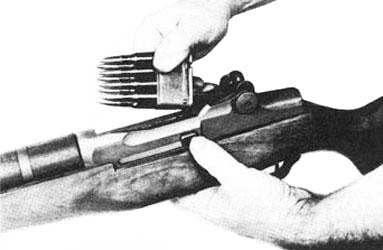
Inserting an M1 "en bloc" clip.
The Garand is loaded with a full clip of 8 cartridges. Once all eight rounds are
expended, the bolt will be automatically locked back and the clip ejected,
readying the rifle for the insertion of a fresh clip of ammunition. Compared to
contemporary detachable box magazines, the M1's "en bloc" clip is light, simple,
and only has to be oriented with the bullets pointing forward prior to charging
the rifle (the clips have no top or bottom).
Once the clip is inserted, the bolt snaps forward on its own as soon as pressure
is released from the clip, chambering a round and leaving it ready to fire. It
is advisable for the operator to ride the bolt forward with his hand (in order
to prevent the bolt from closing on his thumb, resulting in the very common
"Garand thumb" or "M1 thumb"), and to strike the operating rod handle with his
palm to ensure the bolt is closed.
The M1's safety is located at the front of the trigger guard. It is engaged when
it is pressed rearward into the trigger guard, and disengaged when it is pushed
forward and is protruding outside of the trigger guard.
Contrary to widespread misconception, partially expended or full clips can be
ejected from the rifle by means of the clip latch button. It is also possible to
load single cartridges into a partially loaded clip while the clip is still in
the magazine, but this requires both hands and a bit of practice. In reality,
this procedure was rarely performed in combat, as the danger of loading dirt
along with the cartridges increased the chances of malfunction, not to mention
the added delay in returning fire. Later, special clips holding two or five
rounds became available on the civilian market, as well as a single-loading
device which stays in the rifle when the bolt locks back. It is also possible to
modify the clip latch, disabling the clip ejection function, and thereby
allowing the weapon to be charged like a traditional top-loading rifle.
In battle, the manual of arms called for the rifle to be fired until empty, and
then recharged quickly. Due to the well-developed logistical system of the U.S.
military at the time, this wastage of ammunition was generally not critical,
though this could change in the case of units that came under intense fire or
were flanked or surrounded by enemy forces.
The Garand's en-bloc clip system proved particularly cumbersome when using the
rifle to launch grenades, requiring removal of an often partially loaded clip of
ball ammunition and replacement with a full clip of blank cartridges.
Accessories
Both official and aftermarket accessories were plentiful for the Garand rifle.
Several different styles of bayonets fit the rifle: the M1905 and M1942, both
with 16-inch (406 mm) blades; the Model 1905E1 with shortened 10-inch (254 mm)
blade; the M1 with 10-inch (254 mm) blade; and the M5 with 6-inch (152 mm)
blade.
Also available was a grenade launcher that fit onto the barrel using the M7
spigot. It was sighted using the M15 sight, which fit just forward of the
trigger. A cleaning tool, oiler and greasepots could be stored in two
cylindrical compartments in the buttstock for use in the field. Because of the
limitations of the Garand's clip-loading magazine, the rifle proved less than
ideal for use in launching grenades, and the M1903 Springfield was retained for
use in that role long after grenade launchers for the Garand became available.
The M1907 two-piece leather rifle sling was used with the weapon through WWII.
From about 1944 onward, a green cotton webbing sling was provided, eventually
replacing the earlier model.
Another accessory was the winter trigger, said to have been developed during the
Korean War. It consisted in a small mechanism installed on the trigger guard,
allowing the soldier to remotely pull the trigger by depressing a lever just
behind the guard. This enabled the shooter to fire his weapon while using winter
gloves, which could get "stuck" on the trigger guard or not allow for proper
movement of the finger. The device, however, left the trigger completely
exposed, and it is unlikely that the mechanism was left mounted, as it could
easily cause the rifle to be fired accidentally.
Variants
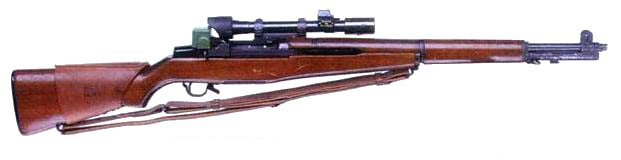

Most variants of the Garand, save the sniper variants, never saw active duty.
The sniper versions were modified to accept scope mounts, and two versions (the
M1C, formerly M1E7, and the M1D, formerly M1E8) were produced, but not in
significant quantities during World War II. The only difference between the two
versions is the mounting system for the telescopic sight. In June of 1944, the
M1C was adopted as a standard sniper rifle by the U.S. Army to supplement the
venerable M1903A4.
The procedure required to install the M1C-type mounts through drilling/tapping
the hardened receiver was inefficient in terms of tooling and time. This
resulted in the development of the M1D, which utilized a simpler, single-ring
Springfield Armory mount. The M1C and M1D first began to be widely used during
the Korean War. The U.S. Marine Corps adopted the M1C as their official sniper
rifle in 1951. The U.S. Navy has also used the Garand, rechambered for the 7.62
× 51 mm NATO round.
Two interesting variants that never saw service were the M1E5 and T26 (popularly
known as the "Tanker Garand"). The M1E5 is equipped with a folding buttstock,
while the T26 uses the standard solid stock, and has a shorter, 18-inch barrel.
The "tanker" name was also used after the war as a marketing gimmick for
commercially-modified Garands. Another variant that never saw duty was the
T20E2. This variant is, at its simplest, a Garand modified to accept Browning
Automatic Rifle (BAR) magazines, and has selective fire capability, with semi-
and fully-automatic modes. Several Ordnance commands at various organizational
levels in the Pacific also modified Garand rifles late in the war to produce
both Garand 'Tanker'-type carbines and BAR-magazine-equipped Garands similar to
the T20E2, though it is unknown if any of these weapons ever saw actual service.
During the 1950s, Beretta produced Garands in Italy at the behest of NATO, by
having the tooling used by Winchester during WWII shipped to them by the U.S.
government. These rifles were designated Model 1952 in Italy, and eventually led
to variants of their own, the best known of these being the BM-59 series.
Beretta Garands chambered in 7.62 × 51 mm NATO served in the Danish armed forces
as the Gv M/50, before being replaced with the Heckler & Koch G3.
| U.S. Army designation | U.S. Navy designation | Description |
|---|---|---|
| T1 | N/A | Prototype |
| T1E1 | N/A | A single trial rifle that broke its bolt in the 1931 trial |
| T1E2 | N/A | Trial designation for gas-trap Garand. Basically a T1E1 with a new bolt. |
| M1 | N/A | Basic model. Identical to T1E2. Later change to gas port did not change designation |
| M1E1 | N/A | M1 Garand variant; modified cam angle in op-rod |
| M1E2 | N/A | M1 Garand variant; prismatic scope and mount |
| M1E3 | N/A | M1 Garand variant; roller added to bolt’s cam lug (later adapted for use in the M14) |
| M1E4 | N/A | M1 Garand variant; gas cut-off and expansion system with piston integral to op-rod |
| M1E5 | N/A | M1 Garand variant; 18-inch barrel and folding stock |
| M1E6 | N/A | M1 Garand variant; sniper variant |
| M1E7/M1C | N/A | M1E6 Garand variant; sniper variant with M81 scope (though the M82 or M84 scope could be used) on a Griffin and Howe mount |
| M1E8/M1D | N/A | M1E7 Garand variant; sniper variant with M82 scope (though the M84 scope could be used) on a Springfield Armory mount |
| M1E9 | N/A | M1 Garand variant; similar to M1E4, with piston separate from op-rod |
| M1E10 | N/A | M1 Garand variant; variant with the "Ljungman" direct gas system |
| M1E11 | N/A | M1 Garand variant; short-stroke Tappet gas system |
| M1E12 | N/A | M1 Garand variant; gas impingement system |
| M1E13 | N/A | M1 Garand variant; "White" gas cut-off and expansion system |
| M1E14 | Mk 2 Mod 0 | M1 Garand variant; rechambered in .30 T65/7.62 × 51 mm NATO with press-in chamber insert |
| T20 | N/A | M1 Garand variant; select-fire conversion by John Garand, capable of using BAR magazines |
| T20E1 | N/A | T20 variant; uses its own type of magazines |
| T20E2 | N/A | T20 variant; E2 magazines will work in BAR, but not the reverse |
| T20E2HB | N/A | T20E2 variant; HBAR variant |
| T22 | N/A | M1 Garand variant; select-fire conversion by Remington, magazine-fed |
| T22E1 | N/A | T22 variant; unknown differences |
| T22E2 | N/A | T22 variant; unknown differences |
| T22E3 | N/A | T22 variant; unknown differences; uses T27 fire control |
| T26 | N/A | M1 Garand variant; 18-inch barrel and standard stock |
| T27 | N/A | Remington select-fire field conversion for M1 Garand; ability to convert issue M1 Garands to select-fire rifles; fire control setup used in T22E3 |
| T35 | Mk 2 Mod 2 | M1 Garand variant; rechambered for .30 T65/7.62 × 51 mm NATO |
| T36 | N/A | T20E2 variant; T20E2 rechambered for .30 T65/7.62 × 51 mm NATO using T35 barrel and T25 magazine |
| T37 | N/A | T36 variant; same as T36, except in gas port location |
Descendants
As stated earlier, the M1 Garand was the direct predecessor of the M14 rifle
that replaced it. During the 1950s, Beretta developed the BM-59 series of
rifles, which would also be produced, under license, in Indonesia as the "SP"
series. Ruger produced the Mini-14 rifle, which utilizes a reduced-size
operating system and a different gas system. The AK-47 was developed from an
earlier Kalashnikov carbine which heavily drew from the Garand design;
particularly, the locking system with its rotating bolt is based on Garand's
design. The AK-47 also uses a highly simplified form of the Garand trigger
group.
Despite similarities in naming, there is no relationship between the M1 Garand
and the M1 Carbine, other than a similar rotating bolt design. Additional
confusion may come from the adoption of several other "M1" weapons ("M" being an
abbreviation for Model), such as the M1 Thompson submachine gun and M1 Abrams
tank.
Civilian use
United States citizens meeting certain qualifications may purchase U.S. military
surplus M1 Garand rifles through the Civilian
Marksmanship Program (CMP). The CMP is run by the Corporation for the
Promotion of Rifle Practice and Firearms Safety (CPRPFS), a not-for-profit
corporation created by the United States Congress in 1996 to instruct citizens
in marksmanship and promote practice and safety in the use of firearms. From
1903 to 1996, the CMP was the DCM (Department of Civilian Marksmanship). It was
initiated by Theodore Roosevelt to promote civilian marksmanship after he
witnessed the lack of skilled marksmen during the Spanish-American War. The DCM
was administered by the Department of Defense, formerly known as the Department
of War. Military surplus Garands and post-war copies made for the civilian
market are popular among enthusiasts around the world.
The Philippine government still issues M1 Garand rifles, together with M1
Carbines, M14s and M16s to their civilian defense forces known as Civilian
Auxiliary Forces Geographical Unit (CAFGU) and Civilian Volunteer Organization (CVO).
Links To Other M1 Garand Web Sites