
Home Vacations France, England, Scotland Previous Page Next Page
Friday. July 21, 2006
We departed Paris this morning via British Airways to London. Arriving at Heathrow we exchanged out Euros for Pounds and caught a taxi to the Crowne Plaza Hotel LONDON-ST. JAMES. He hotel was only 2/10's of a mile from Buckingham Palace, so this was the first thing we visited.
Buckingham
Palace is the official London residence of the British monarch. The Palace
is a setting for state occasions and royal entertaining, a base for all
officially visiting Heads of State, and a major tourist attraction. It has been
a rallying point for British people at times of national rejoicing, crisis or
grief. "Buckingham Palace" or simply "The Palace" is a common metonym used when
referring to the source of Press statements issued by the offices of the Royal
Household.
In the Middle Ages, Buckingham Palace's site formed part of the Manor of Ebury.
It had several Royal owners from Edward the Confessor onwards and was also the
object of much property speculation. (A loophole in the lease of Charles I
allowed the area to revert back to royal hands in the 18th century.) Precursors
of Buckingham Palace were Blake House, Goring House, and Arlington House.
Originally known as Buckingham House, the building forming the core of today's
palace was formerly a large townhouse built for the Duke of Buckingham in 1703
and acquired by King George III in 1762 as a private residence. It was enlarged
over the next 75 years, principally by architects John Nash and Edward Blore,
forming three wings around a central courtyard. Buckingham Palace finally became
the official royal palace of the British monarch on the accession of Queen
Victoria in 1837. The last major structural additions were made in the late 19th
and early 20th Century, when the large East wing facing The Mall was added, and
the former State entrance, Marble Arch, was removed to its present position near
Speakers' Corner in Hyde Park. The East Front was refaced in Portland stone in
1913 as a backdrop to the Victoria Memorial, creating the present-day 'public
face' of Buckingham Palace, including the famous balcony.
The original early 19th century interior designs, many of which still survive,
included widespread use of brightly coloured scagliola and blue and pink lapis,
on the advice of Sir Charles Long. King Edward VII oversaw a partial
redecoration in a Belle epoque cream and gold colour scheme. Many smaller
reception rooms are furnished in the Chinese regency style with furniture and
fittings brought from the Royal Pavilion at Brighton and from Carlton House
following the death of King George IV. The Buckingham Palace Gardens are the
largest private gardens in London, originally landscaped by Capability Brown,
but redesigned by William Townsend Ailton of Kew Gardens and John Nash. The
artificially-created lake was completed in 1828 and is supplied with water from
the Serpentine, a lake in Hyde Park.
The State Rooms form the nucleus of the working Palace and are used regularly by
The Queen and members of the Royal family for official and State entertaining.
Buckingham Palace is one of the world's most familiar buildings and more than
50,000 people visit the Palace each year as guests to banquets, lunches,
dinners, receptions and the Royal Garden Parties.
Jim and ReJeana at Buckingham Palace
The Victoria Memorial is a sculpture in London, placed at the
centre of Queen's Gardens in front of Buckingham Palace, .
It was built by the sculptor Sir Thomas Brock, in 1911. The surround was
constructed by the architect Sir Aston Webb, from 2,300 tons of white marble. It
is a Grade I listed building.
It has a large statue of Queen Victoria facing north-eastwards towards The Mall.
The other sides of the monument feature dark patinated bronze statues of the
Angel of Justice (facing north-westwards toward Green Park), the Angel of Truth
(facing south-eastwards) and Charity facing Buckingham Palace. On the pinnacle,
is Victory with two seated figures. The subsidiary figures were generously
gifted by the people of New Zealand.
The whole sculpture has a nautical theme, much like the rest of the mall
(Admiralty Arch etc). This can be seen in the mermaids, mermen and a hippogriff,
all of which are suggestive of Great Britain ruling the waves.
The Victoria Memorial

Guard at Buckingham Palace

Guard at Buckingham Palace

The Victoria Memorial

Buckingham Palace seen from The Victoria Memorial

Buckingham Gate

ReJeana in front of The Victoria Memorial

Fountain at The Victoria Memorial

Fountain at The Victoria Memorial

Buckingham Palace and The Victoria Memorial

Buckingham Palace

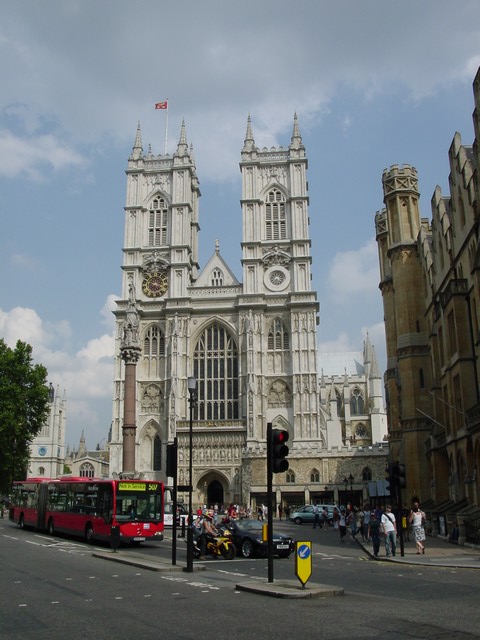
The Collegiate Church
of St Peter, Westminster, which is almost always referred to as Westminster
Abbey, is a mainly Gothic church, on the scale of a cathedral, in Westminster,
London, just to the west of the Palace of Westminster. It is the traditional
place of coronation and burial site for English monarchs.
West front of Westminster Abbey
Big Ben is
the colloquial name of the Clock Tower in the Palace of Westminster, London,
England. It actually refers to the main bell, which is also known as the Great
Bell of Westminster, the largest bell in the tower and part of the Great Clock
of Westminster.
The tower itself is often called St Stephen's Tower, but according to the
parliamentary guides who conduct the official tours of the building, the correct
name is very definitely the Clock Tower.
The note sounded by Big Ben as it chimes the hours is a low E (perhaps slightly
flat). The quarter-hours are chimed by bells tuned to G sharp, F sharp, E and B,
and the musical figure they spell out is said to be taken from "I know that my
Redeemer liveth" from Handel's Messiah.
Clock Tower in the Palace of Westminster

The Clock Tower is a turret clock structure at the north-eastern
end of the Houses of Parliament building in London, UK.
It is colloquially and popularly known as Big Ben, however this name actually
belongs to the clock's main bell. It has also been referred to as St. Stephen's
Tower.
The tower was raised as a part of Charles Barry's design of a new palace, after
the old Palace of Westminster was destroyed by fire on the night of October 16,
1834. The tower is designed in the Victorian Gothic style, and is 96.3 meters
(316 feet) high.
The first 61 meters (200 feet) of the structure is the clock tower, consisting
of brickwork with stone cladding; the remainder of the tower's height is a
framed spire of cast iron. The tower is founded on a 15 by 15 meters (49 by 49
feet) raft, made of 3 meters (9 feet) thick concrete, at a depth of 7 meters (23
feet) below ground level. The tower has an estimated weight of 8,667 tonnes
(9,553 tons). The four clock faces are 55 meters (180 feet) above ground.
Due to ground conditions present since construction, the tower leans slightly to
the north-west, by roughly 220 millimeters (8.66 inches). Due to thermal effects
it oscillates annually by a few millimeters east and west.
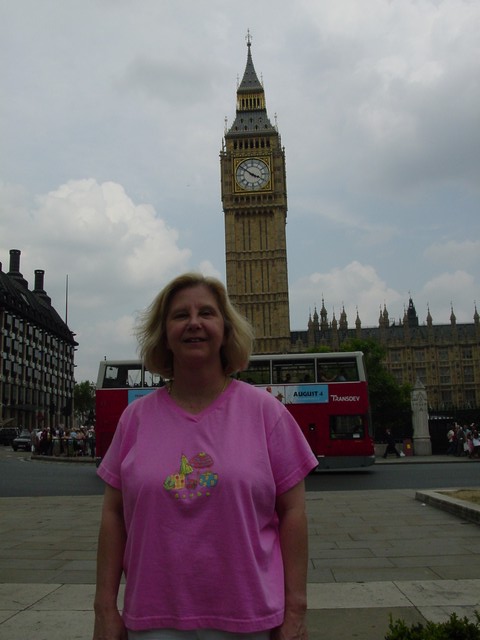
ReJeana and the Clock Tower
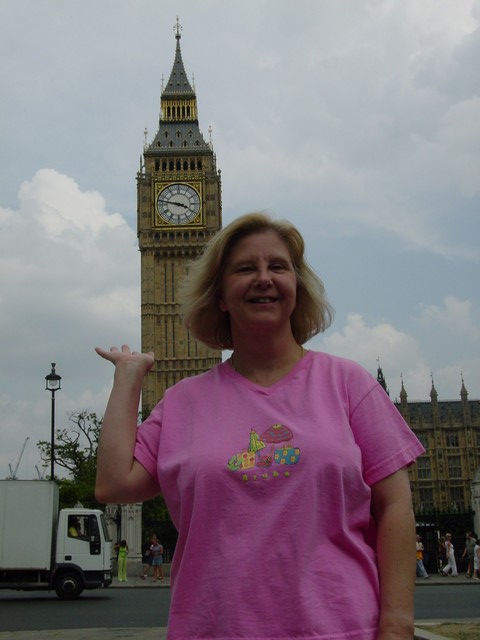
Jim and the Clock Tower

ReJeana and the Clock Tower
The British Airways London
Eye, also known as the Millennium Wheel, opened in 1999 and is the largest
observation wheel in the world (a type of Ferris wheel). It stands 135 metres
(443 feet) high on the western end of Jubilee Gardens, on the South Bank of the
River Thames in Lambeth, London, England, between Westminster and Hungerford
Bridges (Coordinates: 51°30′12″N, 00°07′11″W). It is adjacent to London's County
Hall, and stands opposite the offices of the Ministry of Defense.
London Eye

London Eye

Jim and Jeana on the London Eye

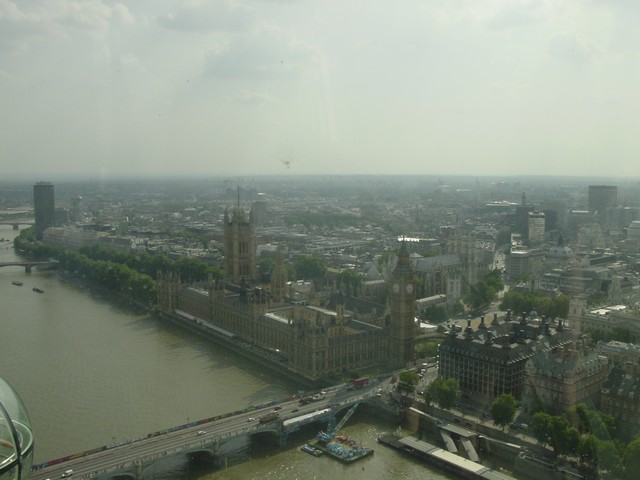
View from the London Eye

View from the London Eye

House of Parliament viewed the London Eye

A pod on the London Eye

A pod on the London Eye

View from the London Eye

View from the London Eye

View from the London Eye
London Eye

River Thames

Home Vacations France, England, Scotland Previous Page Next Page