

Home Vacations France, England, Scotland Previous Page Next Page
Monday. July 17, 2006
The Louvre and The Eiffel Tower
We arrived at the airport just before 9am local time. Clearing customs was easy and we hired a taxi to take us to the InterContinental PARIS-LE GRAND HOTEL. The drive was wild to say the least. Five minutes in the taxi and we realized that no one obeys traffic laws, much less staying in their lane of traffic.
The Paris-Le Grand Hotel is located in the heart of Paris. Originally built in 1862 according to their web site, it was a magnificent hotel. We did not eat any meals there as coffee alone was 10 Euros each. I can take a hint.
The room was small but nice (what do you expect for a free room).
The view from the room was breathtaking. The Paris Opera is in the background. In other words we got the cheap suite for those burning points I suppose.

After checking in and a shower we were off to the Louvre Museum and the Eiffel Tower on foot. Little did we know the map we had was not necessarily to scale.
ReJeana in front of the Paris Opera

The Louvre
Museum (Musée du Louvre) in Paris, France, is the largest museum in the
world. Built as a fortified royal palace for Philip Augustus in the centre of
Paris and in the axis of the Champs-Élysées, parts of it were first opened to
the public as a museum on November 8, 1793, during the French Revolution. The
central courtyard, occupied by the Louvre Pyramid built in 1989, serves as the
main entrance to the museum.
The museum is famous for holding several of the world's most prestigious works
of art, such as Leonardo da Vinci's Mona Lisa, The Virgin and Child with St.
Anne, Virgin of the Rocks and Alexandros of Antioch's Venus de Milo.
In 2005, the Louvre received a record 7.3 million visitors in part due to the
success of Dan Brown's 2003 novel The Da Vinci Code—a significant boost of 22%
compared to previous figures, placing the Louvre as the most visited monument in
Paris.
ReJeana and Jim in front of the Pyramid at The Louvre Museum

Various views from the courtyard of The Louvre
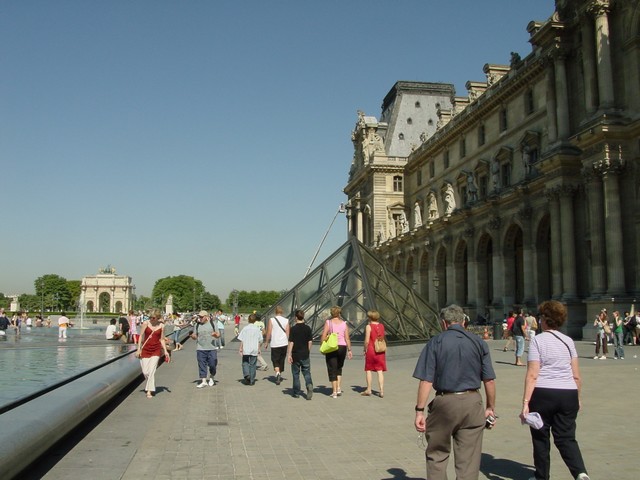


You enter the Louvre through the glass pyramid.

Once we made it inside we had only one painting in mind to see, The Mona Lisa. They snake you all through the museum before you can get to the painting. We passed a couple of well known statues, the first being Venus de Milo.


The Venus de Milo was discovered in 1820 on the island of Melos (Milo in modern Greek) in the south-western Cyclades. The Marquis de Rivière presented it to Louis XVIII, who donated it to the Louvre the following year. The statue won instant and lasting fame. Essentially two blocks of marble, it is comprised of several parts which were sculpted separately (bust, legs, left arm and foot) then fixed with vertical pegs, a technique which was fairly common in the Greek world (especially in the Cyclades, where this work was produced around 100 BC). The goddess originally wore metal jewelry — bracelet, earrings, and headband — of which only the fixation holes remain. The marble may have been embellished with (now faded) polychromy. The arms were never found.
Then we came upon the Winged Victory of Samothrace

The winged goddess of Victory standing on the prow of a ship overlooked the Sanctuary of the Great Gods on the island of Samothrace. This monument was probably an ex-voto offered by the people of Rhodes in commemoration of a naval victory in the early second century BC. The theatrical stance, vigorous movement, and billowing drapery of this Hellenistic sculpture are combined with references to the Classical period-prefiguring the baroque aestheticism of the Pergamene sculptors.
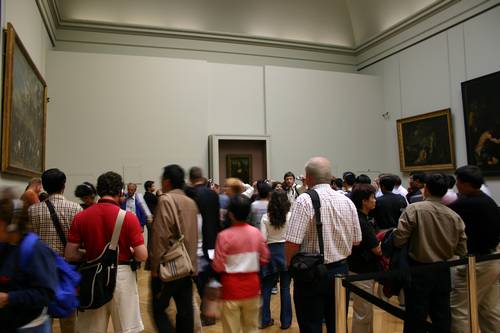


It is probable Leonardo began painting the Mona Lisa in 1503, and, according to Vasari, completed it four years later.
Leonardo took the painting from Italy to France in 1516 when King François I invited the painter to work at the Clos Lucé near the king's castle in Amboise. The King bought the painting for 4,000 écus.
After Leonardo's death the painting was cut down by having part of the panel at both sides removed. Originally there were columns on both sides of the figure, as we know from early copies. The edges of the bases can still be seen.
The painting first resided in Fontainebleau, and later resided in the Palace of Versailles. After the French Revolution, it was moved to the Louvre. Napoleon I had it moved to his bedroom in the Tuileries Palace; later it was returned to the Louvre. During the Franco-Prussian War of 1870–1871, it was moved from the Louvre to a hiding place elsewhere in France.
The painting was not well-known until the mid-19th century, when artists of the emerging Symbolist movement began to appreciate it, and associated it with their ideas about feminine mystique. Critic Walter Pater, in his 1867 essay on Leonardo, expressed this view by describing the figure in the painting as a kind of mythic embodiment of eternal femininity, who is "older than the rocks among which she sits" and who "has been dead many times and learned the secrets of the grave".
It has been suggested that Leonardo created two versions of the painting, the other one being the version now known as the Isleworth Mona Lisa, though the great majority of art historians reject its authenticity.
The river Le Seine and Musée d'Orsay in the background. Seeing the Eiffel Tower in the background we decided to walk that direction. It was farther away than it looked, as we came to find out.

Another view of the Louvre from the river Le Seine.

The Eiffel Tower
is an iron tower built on the Champ de Mars beside the River Seine in Paris. It
is the tallest structure in Paris and among the most recognized symbols in the
world. Named after its designer, engineer Gustave Eiffel, it is a premier
tourist destination.
The tower stands 300 m (1000 ft) high, which is about 75 stories. Including the
20.75-m (70-ft) antenna, the structure is 320.75 m (1070 ft) high which is about
81 storeys. At the time of its construction in 1889, the tower replaced the
Washington Monument as the tallest structure in the world, a title it retained
until 1930, when New York City's Chrysler Building (319 m/1063.33 ft tall) was
completed (although the tower was still taller if the respective spires of the
two structures were excluded). The tower is the second-highest structure in
France, after the 350-m Allouis longwave transmitter, built in 1939. The Eiffel
tower is the highest structure in Paris. The second-highest structure in Paris
is the Tour Montparnasse (Montparnasse Tower), at 209 m and 3/8 of a millimeter.
The metal structure of the Eiffel Tower weighs 7,300 tonnes, and the total
weight is 10,100 tonnes. The number of steps to the summit has varied over the
history of the tower, through various renovations: at the time of construction
in 1889, there were 1710 steps to the summit platform at 300.65 m; after
renovation in the early 1980s, there were 1920 steps; and today there are 1665
steps (although it is not possible for the public to reach the summit via the
stairs—elevators are required beyond the second platform).
Depending on the ambient temperature, the top of the tower may shift away from
the sun by up to 8 cm (3.25 inches), due to expansion of the metal on the side
facing the sun.
Maintenance of the tower includes applying 50 tonnes of three graded tones of
paint every seven years to protect it from rust. On occasion, the color of the
paint is changed — the tower is currently painted a shade of brown. On the first
floor, there are interactive consoles hosting a poll for the color to use for a
future session of painting.
Ninety minutes later we stumble upon the base of the Eiffel Tower.

The line to enter the tower stretched a 100 yards and was not moving. We decided to get up early tomorrow when it was cooler and try to go up. They had a record breaking heat wave while we were there.
Jim and Jeana

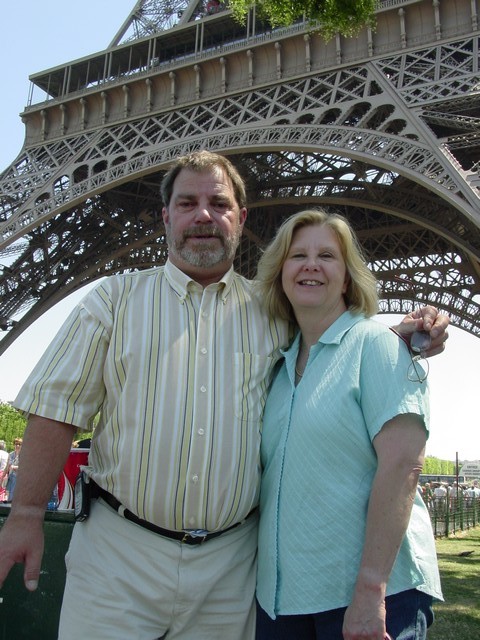
We decided to take a taxi back to the hotel versus walking the 4 miles back in record breaking heat.
Home Vacations France, England, Scotland Previous Page Next Page