
Home Vacations France, England, Scotland Previous Page Next Page
Saturday. July 22, 2006
Victoria Station
Victoria Station

Changing of the Guard at Buckingham Palace

Changing of the Guard at Buckingham Palace

Changing of the Guard at Buckingham Palace

Changing of the Guard at Buckingham Palace

Changing of the Guard at Buckingham Palace
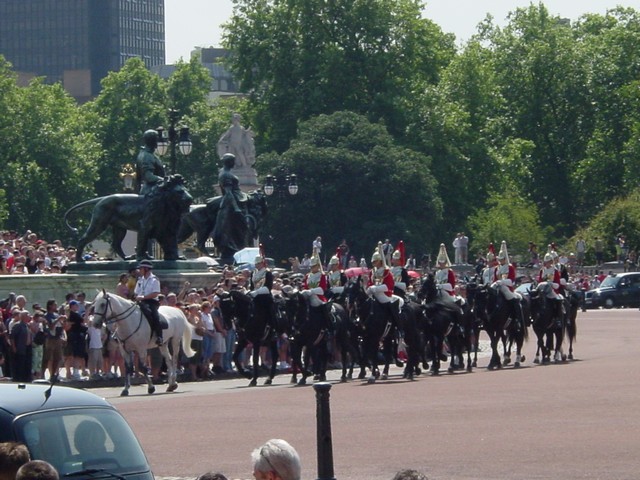
Changing of the Guard at Buckingham Palace

The London Underground is a metro railway
system in England that covers much of the conurbation of Greater London and some
neighbouring areas. It is the world's oldest underground system, and is the
largest in terms of route length. Service began on 10 January 1863 on the
Metropolitan Railway, from which the term "metro" is derived; most of the
initial route is now part of the Hammersmith & City Line. Despite its name,
about 55% of the network is above ground. Popular local names include the
Underground and, more colloquially, the Tube, in reference to the cylindrical
shape of the system's deep-bore tunnels.
The Underground is an electric railway and currently serves 274 stations and
runs over 408 km (253 miles) of lines[1]. There are also a number of former
stations and tunnels that are now closed. In 2004–2005, total passenger journeys
reached a record level of 976 million, an average of 2.67 million per day.
Since 2003, the Underground has been part of Transport for London (TfL), which
also administers London's buses, including the famous red double-deckers, and
carries out numerous other transport-related functions in the capital.
Previously, London Regional Transport was the holding company for London
Entrance to the Underground

Tower Bridge is a bascule bridge in London, England over the River Thames. It is close to the Tower of London, which gives it its name. It is sometimes mistakenly called London Bridge, which is the next bridge upstream. The bridge is owned and maintained by Bridge House Estates, a charitable trust overseen by the Corporation of London.
Tower Bridge

Construction of the bridge started in 1886 and
took 8 years, employing 5 major contractors and 432 construction workers. Two
massive piers, containing over 70,000 tons of concrete, were sunk into the river
bed to support the construction. Over 11,000 tons of steel provided the
framework for the towers and walkways. This was then clad in Cornish granite and
Portland stone, both to protect the underlying steelwork and to give the bridge
a pleasing appearance.
Jones died in 1887, and his chief engineer, Sir John Wolfe-Barry, took over the
project. Wolfe-Barry replaced Jones' original mediaeval style of facade with the
more ornate Victorian gothic style that makes the bridge a distinctive landmark.
The bridge was opened on 30 June 1894 by the Prince of Wales, the future King
Edward VII of the United Kingdom, and his wife, Alexandra of Denmark.

ReJeana and Jim in front of the Tower Bridge


Home Vacations France, England, Scotland Previous Page Next Page