Home Vacations France, England, Scotland Previous Page Next Page
Thursday. July 20, 2006
Today we headed off to Mount Saint-Michel.
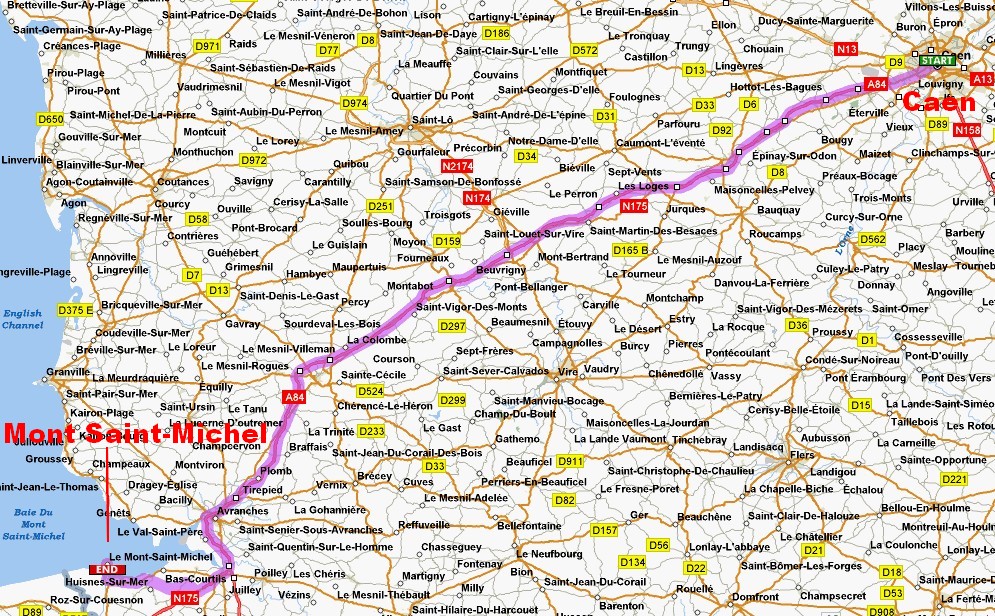
Caen to Mount Saint-Michel 77.2 miles
Mont Saint-Michel (English: Mount Saint Michael) is a small rocky tidal island in Normandy, roughly one kilometre from the north coast of France at the mouth of the Couesnon River near Avranches, close to the border of Brittany, which has led to Breton claims to the mount. Originally the Couesnon formed the border between the two duchies, and every so often the river would shift its bank, leading to ownership of the mount shifting between them. The river's bed has now been fixed and Mont Saint Michel is now firmly in Norman hands. It is home to the unusual Benedictine Abbey and steepled church (built between the 11th and 16th centuries) which occupy most of the one-kilometer-diameter clump of rocks jutting out of the waters of the English Channel. The church is crowned by a gold leaf statue of St. Michael by Emmanuel Frémiet, reaching a height of 155 metres (510 feet) above the sea.

Le Mont-St-Michel was used in the 6th and 7th
centuries as an Armorican stronghold of Romano-British culture and power, until
it was sacked by the Franks, thus ending the trans-channel culture that had
stood since the departure of the Romans in AD 459.
Before the construction of the first monastic establishment in the 8th century,
the island was called Mont Tombe. According to legend, the archangel Michael
appeared to St. Aubert, bishop of Avranches, in 708 and instructed him to build
a church on the rocky islet. Aubert repeatedly ignored the angel's instruction,
until Michael burned a hole in the bishop's skull with his finger. The
dedication to St. Michael occurred on 16 October 708.

The mount gained strategic significance in 933
when the Normans annexed the Cotentin Peninsula, thereby placing the mount on
the new frontier with Brittany. It is depicted in the Bayeux Tapestry, which
commemorates the 1066 Norman conquest of England. Ducal and royal patronage
financed the spectacular Norman architecture of the abbey in subsequent
centuries.
During the Hundred Years' War the English made repeated assaults on the island
but were unable to seize it partly due to the abbey's improved fortifications.
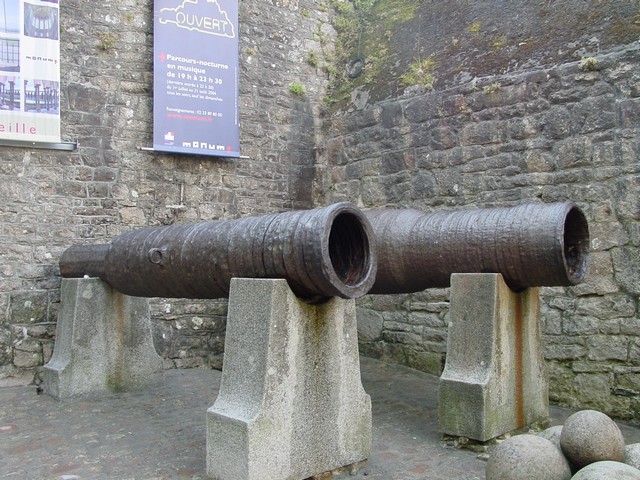
Les Michelettes, two wrought-iron bombards left by the English in their failed
1423-24 siege of Mont-St-Michel, are still displayed near the outer defense
wall.
The wealth and influence of the abbey extended to many daughter foundations,
including St Michael's Mount in Cornwall, England. However, its popularity and
prestige as a centre of pilgrimage waned with the Reformation, and by the time
of the French Revolution there were scarcely any monks in residence. The abbey
was closed and converted into a prison, initially to hold clerical opponents of
the republican régime. High-profile political prisoners followed, but by 1836
influential figures, including Victor Hugo, had launched a campaign to restore
what was seen as a national architectural treasure. The prison was finally
closed in 1863, and the mount was declared a historic monument in 1874. The Mont
Saint Michel and its bay were added to the UNESCO list of World Heritage Sites
in 1979, as they rank high on such World Heritage Site criteria as cultural,
historical, and architectural significance, as well as human-created and natural
beauty.

Jim & ReJeana at Mount Saint-Michel

English Bombards


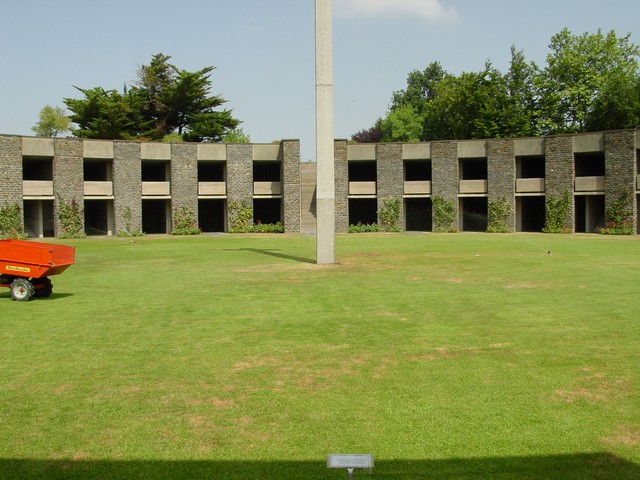
German Military Cemetery
Mont de Huisnes, Manche, in Normandy




Mount Saint-Michel to Paris 222 miles

We headed back to Paris, quite frankly ready to leave. We were in desperate need of some real food. We arrived at the
Holiday Inn PARIS-CHARLES DE GAULLE ARPRT mid afternoon glad to get off the Paris roadways.
Home Vacations France, England, Scotland Previous Page Next Page