
Home Vacations France, England, Scotland Previous Page Next Page
Thursday. July 27, 2006
Off to Scotland we go. We are heading to Edinburg by way of Carlisle and Stirling. We wanted to see Carlisle Castle. Stirling is where Mel Gibson, excuse me, William Wallace defeated Edward the First's forces at The Battle of Stirling Bridge. Also in Sterling is the William Wallace Monument. Wallace was known as the "Guardian of Scotland".
I've become quite accustomed to driving on the wrong side of the road. Too accustomed as we were to find out later. Highway A69 transitions from a two-lane highway to a four-lane divided highway and back to a two-lane along the distance from Newcastle to Carlisle. Building, hedgerows, fences, and other obstructions are built up right next to the roadway. Generally there is no place to pull off the road without hitting something.
Well that morning God was watching over us this morning. I don't know what I was thinking. I surmise that I was thinking I was still on a divided highway as I decided to pass large truck, because there was another large truck tailgating me, but mainly because I don't like being behind slow trucks. I pulled into the right lane and started accelerated past the truck in front. I noticed a hundred yards ahead of me another large truck in my lane heading toward me. Behind him were cares also traveling in the opposite direction. I thought (briefly) why are they in my lane? Then the "light bulb" clicked on. I tried to go back into the lane behind the slow moving truck, but the other truck, originally behind me had closed the gap (jerk). Looking forward again an oncoming truck filled my windscreen (British for windshield). Not thinking I whipped the car to the right.....
....and into a meadow flat as a pool table without any obstructions. We braked to a stop and sat there silently. Now mind you ReJeana has no problem telling me how to drive, and did so throughout the trip, but during the few seconds that this transpired, I never heard a peep out of her. We sat there in the car and did not move, repeatedly saying, "Thank you Jesus! thank you Jesus!", after first shouting obscenities of terror and relief.
No one pulled over to see if we were ok or slowed down to see what we were doing. They probably figured we were stupid tourists that forgot which side of the road to drive on. The onboard GPS woman never muttered a word. Usually when I stray from the computed path she is telling me instructions.
In my defense I must say that in England do not use yellow stripes or dashes to divide oncoming traffic. You just have to know these things. In London on six and eight lane undivided roads you just have to know that only half the lanes are yours. And we had just come from a stretch of divided highway where the oncoming traffic lane was several hundred yards away. So after five minutes or so we pulled back onto the roadway and headed for Carlisle. Needless to say I did not attempt to pass any other vehicles on undivided highways from that point on.
Newcastle to Carlisle 59.5 miles
Once we reached Carlisle, we decided to go onto Stirling, since I was now driving at a reduced speed and obeying the limit, I didn't want to run out of daylight.
Carlisle to Stirling 113.7 miles

Stirling Castle was unmistakable to miss as it sat high upon a cliff overlooking the city.

After getting lost a couple of times because the other front seat driver (the GPS) did not know how to tell me to get there, we finally found the entrance. Then we found out we would have to park at the bottom of the hill and walk up to it, we said, "NOT!" So we headed on to the Wallace monument.

The Wallace Monument was also located at the top of a very large hill or small mountain, you decide. But they did have a bus to take you to the top. I voted to walk up to it but I was vetoed.

The
Wallace National Monument
(generally known as the Wallace Monument) is a tower standing on the summit of
Abbey Craig, a hilltop near Stirling in Scotland. It commemorates William
Wallace, the 13th century Scottish hero.
The tower was constructed following a fundraising campaign which accompanied a
resurgence of Scottish national identity in the 19th century. In addition to
public subscription, it was partially funded by contributions from a number of
foreign donors, including Italian national leader Giuseppe Garibaldi. Completed
in 1869, the monument is a 220 foot sandstone tower, built in the Victorian
Gothic style. It stands on the Abbey Craig, a volcanic crag above Cambuskenneth
Abbey, from which Wallace was said to have watched the gathering of the army of
English king Edward I, just before the Battle of Stirling Bridge.
The monument is open to the general public. Visitors climb the 246 step spiral
staircase to the viewing gallery inside the monument's crown, which provides
expansive views of the Ochil Hills and the Forth Valley.
A number of artifacts believed to belong to Wallace are on display inside the
monument, including a 5 foot 4 inch-long claymore sword.

In 1997, a statue of “William Wallace” was
placed in the car park of the Wallace Monument. The statue however appeared not
to resemble the historic face of Wallace; rather it looked more like the actor
who portrayed him in the film Braveheart, Mel Gibson. Wallace’s shield even
reads the word ‘Braveheart’.
Temby (2004) claimed that Scottish people found this disturbing and that groups
have protested for the removal of the statue due to its obvious lack of
authenticity, and as a result of officials denying the request, the statue was
defaced. “How sad is it to think that most of the world will never envision the
7-foot-tall Scotsman that can shoot lightning bolts out of his arse-but rather
will recall the slightly deranged performance of Gibson instead” (Temby, W.
2004).
Though it was not as if a statue of Wallace was replaced with one of Mel Gibson;
rather an addition was made to the site to give it more cultural appreciation,
by acknowledging that this film had a significant role in promoting this
relatively unknown Scottish figure of history throughout the world. “After
watching the movie, most develop a greater appreciation for the general ways of
life and the history of the world” (Sullivan, ND).
This signifies that there is an importance of consumer culture in this historic
site. This statue was about giving this site cultural appreciation in a socially
appropriate (less formal) environment. Those who are not familiar with Wallace
(children etc.), may relate with Gibson, and therefore they might develop an
interest in this site.
Jeana with her hero


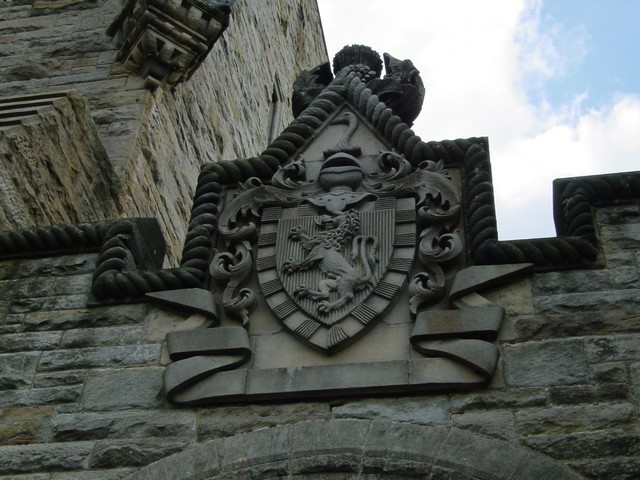
I assume this to be William Wallace, but I see no lightning bolts

The "Wallace Sword", all 5'4" of it.

I have no idea who these people are portrayed in the following stained glass images, but I thought they were cool so I photographed them.

William Wallace?
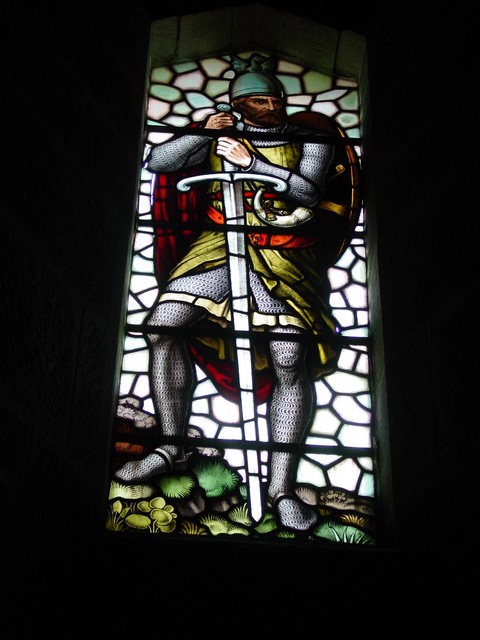


Robert I, (Roibert a Briuis in mediaeval
Gaelic, Raibeart Bruis in modern Scottish Gaelic and Robert de Brus or Robert de
Bruys in Norman French), usually known in modern English today as Robert the
Bruce (11 July 1274 – 7 June 1329), was King of Scotland (1306 – 1329).
Although his paternal ancestors were of Scoto-Norman heritage, his maternal
ancestors were Gaelic, and he became one of Scotland's greatest kings, as well
as one of the most famous warriors of his generation, eventually leading
Scotland during the Wars of Scottish Independence against England. He claimed
the Scottish throne as a great-great-great-great grandson of David I of
Scotland.
His body is buried in Dunfermline Abbey, while his heart is buried in Melrose
Abbey. His heart was to be taken on crusade to the Holy Land but only made it as
far as Spain.
Bust of "Robert the Bruce"

View of the city of Stirling from the Wallace Monument


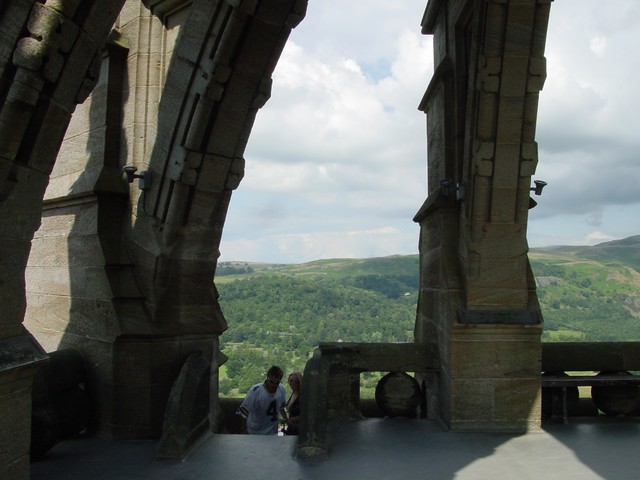
ReJeana, windblown

Jim

ReJeana in front of the Wallace Monument

Jim in front of the Wallace Monument
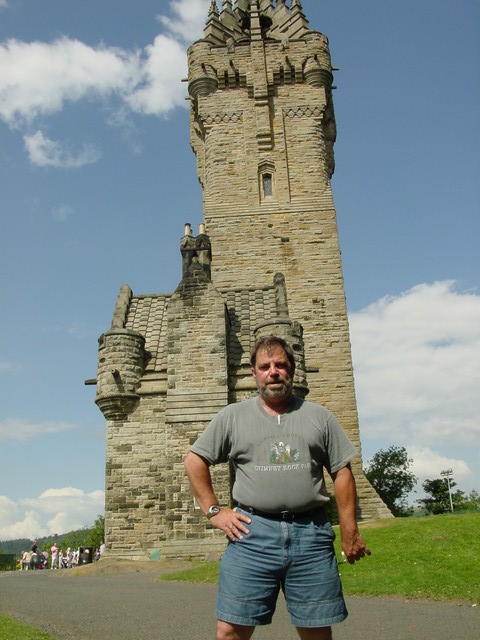
I talked the wife into walking down the hill as there were nothing but old people boarding the bus. We were the youngest riding it up.
It was only mid afternoon and we decided to head toward to Edinburg.
Stirling Bridge - 15th Century Bridge near the site of the Battle of Stirling Bridge

While on the road to Edinburg, Jeana was thumbing through some brochures and found a castle on the other side of Edinburg, Tantallon Castle, she wanted to see. So we punched in the coordinates of the nearest town, North Berwick and off we went.
Sterling to Tantallon Castle 67.6 miles

Tantallon Castle is located 3 miles east of
North Berwick in Scotland. It sits atop a cliff face opposite Bass Rock, looking
out onto the Firth of Forth. Currently in ruins, it is now in the care of
Historic Scotland.
The history of the castle dates back to 1358. Twelve years prior, William
Douglas had returned from France to Scotland to claim his inheritance after the
Battle of Neville's Cross. By murdering his godfather, William, Knight of
Liddesdale, in the Ettrick Forest, William became the undisputed head of the
House of Douglas; he was made the first Earl of Douglas in 1358. The building of
Tantallon Castle during this time was probably the result of his newly acquired
wealth and status. William, Earl of Douglas, died in 1384. His heir James did
not long outlive him, dying in 1388 at the Battle of Otterburn.
In 1389 Margaret, Countess of Angus, resigned her Earldom in favour of her son,
George. George Douglas thus became the first Douglas Earl of Angus and Mar, and
lord of Tantallon Castle. This contributed to the division in the House of
Douglas. Archibald, illegimate son of James Douglas, became head of the main
line, known as the ‘Black Douglases’, the Douglases of Angus becoming the ‘Red
Douglases’.
In 1491 Tantallon Castle was besieged by King James IV, but did not suffer much
damage. It was besieged again in 1528, and this time passed into the hands of
James V. To repair the siege's devastation, a new Fore Tower was built up to the
battlements. The East Tower was also altered; it had originally consisting of
five floors, but the bottom three were reduced to two by inserting stone vaults,
which improved resistance to artillery. Defenses were further improved by
wide-mouthed gunholes punched through the landward walls of the tower.
Crenellated parapets were added to the main curtain wall.
In 1651 Tantallon Castle, was besieged and taken by the army of Oliver Cromwell.
Cromwell's forces had invaded Scotland when Tantallon Castle was occupied by a
small group of bandits, who set about attacking Cromwell's lines of
communication across south east Scotland and were said to be more effective than
all the regular troops opposing Cromwell across Scotland combined.
When Cromwell discovered this, he retaliated swiftly. It took a force of 3,000
men, including much of Cromwell's artillery in Scotland, to defeat the fewer
than 100 men holding the castle. After the siege Tantallon was left in ruins.


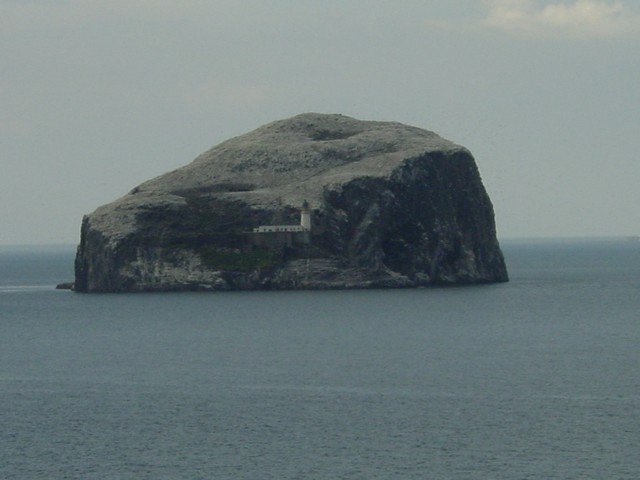
Bass Rock is an island in the outer part of the
Firth of Forth in the east of Scotland, approximately one mile off North
Berwick. Its correct name is the Island of The Bass.
The island is a volcanic plug and stands over 100 m high in the Firth of Forth
Islands Special Protection Area which covers some, but not all of the islands in
the inner and outer Firth. Bass Rock is a Site of Special Scientific Interest in
its own right, due to its Gannet colony. It is sometimes called "the Ailsa Craig
of the East".
It plays host to at least 40,000 pairs of Gannets (birds) and is the largest
single rock gannetry in the world so that, when viewed from the mainland, large
regions of the surface appear white due to the sheer number of birds (and their
droppings). In fact the scientific name for the Northern Gannet, Sula bassana or
Morus bassanus, derives its name from the rock. They were traditionally known
locally as 'Solan Goose'.

It is also home to a 20 meter lighthouse, built in 1902 by David Stevenson, who demolished the 13th century keep, or governor's house, and some other buildings within the castle for the stone. It has been unmanned since 1988.


We departed Tantallon Castle for the
Holiday Inn
EDINBURGH-NORTH. It took us a while to weave our way through downtown
as our GPS got a bit confused by the main roads through the city center being
taxi and bus only.
This hotel, a regular Holiday Inn had an A/C that was more than cold enough to suit me. But, as I expected, no guest laundry.
Tantallon Castle to Edinburg 27.7 miles

Home Vacations France, England, Scotland Previous Page Next Page