
Home Vacations France, England, Scotland Previous Page Next Page
Tuesday. July 18, 2006
Being lazy we decided to take a cab to the Eiffel Tower
Eiffel Tower

Gustave Eiffel
Alexandre Gustave Eiffel (December 15, 1832 –
December 27, 1923; was a French engineer and architect and a specialist of
metallic structures. He is famous for designing the Eiffel Tower, built 1887-
1889 for the 1889 Universal Exposition in Paris, France, and the armature for
the Statue of Liberty, New York Harbor, USA.

Jim and Jeana atop the Eiffel Tower
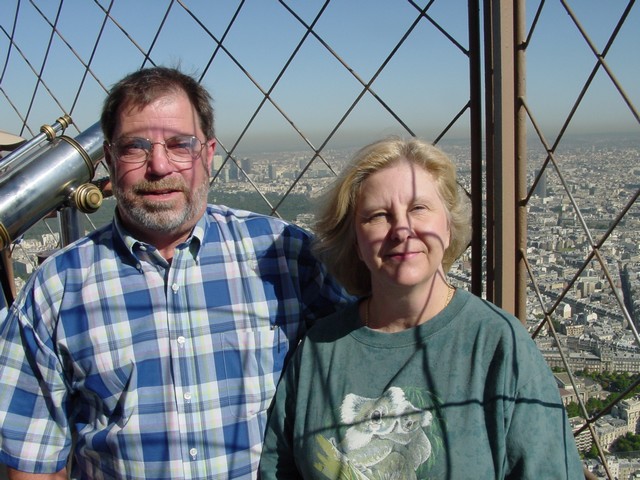
Jim and Jeana atop the Eiffel Tower

Eiffel Tower

View atop the Eiffel Tower

View atop the Eiffel Tower

View atop the Eiffel Tower

View atop the Eiffel Tower

View atop the Eiffel Tower
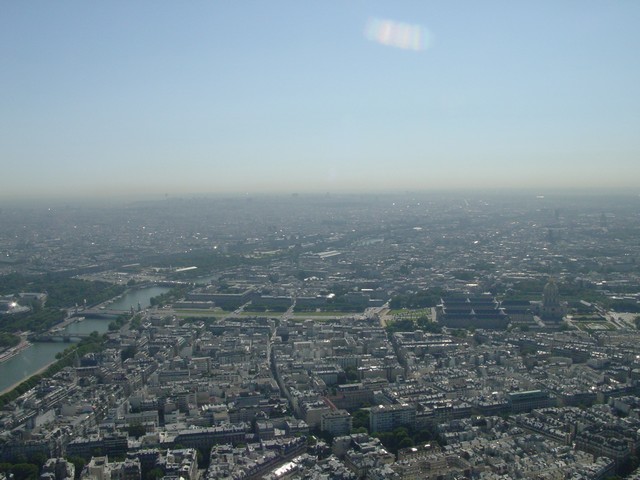
View atop the Eiffel Tower

View atop the Eiffel Tower

View atop the Eiffel Tower

View atop the Eiffel Tower

View atop the Eiffel Tower

View atop the Eiffel Tower

View atop the Eiffel Tower

View atop the Eiffel Tower

View atop the Eiffel Tower

View atop the Eiffel Tower

View atop the Eiffel Tower

View atop the Eiffel Tower

View atop the Eiffel Tower
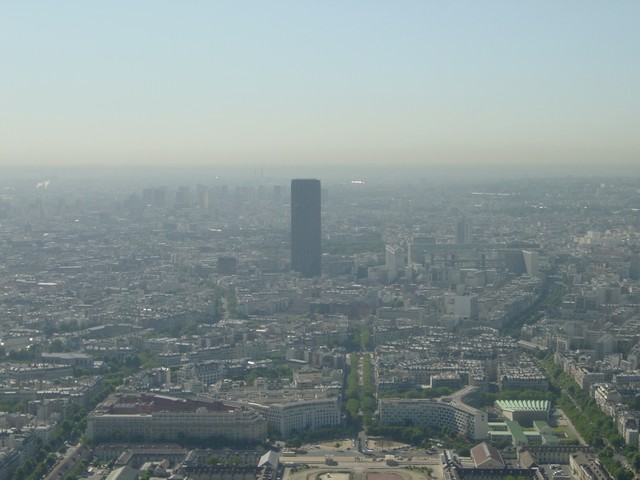
View atop the Eiffel Tower

Jeana & Jim at the Eiffel Tower

Jeana in front of the Eiffel Tower

Eiffel Tower

Les Invalides
Les Invalides in Paris, France consists of a
complex of buildings in the 7th arrondissement containing museums and monuments,
all relating to France's military history, as well as a hospital and a
retirement home for war veterans, the building's original purpose. It is also
the burial site for some of France's war heroes.
King Louis XIV initiated the project by an order dated November 24, 1670, as a
home and hospital for aged and unwell soldiers: the name is a shortened form of
hôpital des invalides, the hospital for invalids. The architect of Les Invalides
was Libéral Bruant. The selected site was suburban in the 17th century. By the
time the enlarged project was completed in 1676, the river front measured 196
metres and the complex had fifteen courtyards, the largest being the cour
d'honneur ("court of honour") for military parades.
St Peter's BasilicaThen it was felt that the veterans required a chapel, in
which Jules Hardouin Mansart assisted the aged Bruant, and finished it in 1679
to Bruant's designs after the elder architect's death. The chapel is known as
Eglise Saint-Louis des Invalides. Daily attendance was required.
Shortly after the veterans' chapel was completed, Louis XIV had Mansart
construct a separate private royal chapel, often referred to as the Église du
Dôme from its most striking feature (ill. right). Inspired by St. Peter's
Basilica in Rome (left) the original for all Baroque domes; it is one of the
triumphs of French Baroque architecture. Mansart raises his drum with an attic
storey over its main cornice, and employs the paired columns motif in his more
complicated rhythmic theme of ||u||uu||u||. The general program is sculptural
but tightly integrated, rich but balanced, consistently carried through capping
its vertical thrust firmly with a less emphatically ribbed and hemispherical
dome. The domed chapel is centrally placed to dominate the court of honor. It
was finished in 1708.
Les Invalides

The most notable tomb at Les Invalides is that
of Napoleon Bonaparte (1769-1821) in the crypt under Mansart's dome. Napoleon
was initially interred on Saint Helena, but King Louis-Philippe arranged for his
remains to be brought to St Jerome's Chapel in Paris in 1840. A renovation of
Les Invalides took many years, but in 1861 Napoleon was moved to the most
prominent location under the dome at Les Invalides.

ReJeana at Napoleon's tomb

Jim at Napoleon's tomb

ReJeana and the Eiffel Tower

Jim and the Eiffel Tower

Arc de Triomphe
The
Arc de Triomphe is a monument
in Paris that stands in the centre of the Place de l'Étoile, at the western end
of the Champs-Élysées. It is the linchpin of the historic axis (L'Axe historique)
leading from the courtyard of the Louvre Palace, a sequence of monuments and
grand thoroughfares on a route leading out of Paris. The monument's iconographic
program pitted heroically nude French youths against bearded Germanic warriors
in chain mail and set the tone for public monuments with triumphant
nationalistic messages until World War I.
The monument stands over 51 metres (165 feet) in height and is 45 metres wide.
It is the second largest triumphal arch in existence (North Korea built a
slightly larger Arch of Triumph in 1982 for the 70th birthday of Kim Il-Sung);
the Arc de Triomphe is so colossal that an early daredevil flew his plane
through it.
It was commissioned in 1806 after the victory at Austerlitz by Napoleon
Bonaparte at the peak of his fortunes and finally completed — after a long pause
during the Restoration — in the reign of King Louis-Philippe, in 1833-36. The
sculpture representing Peace was now interpreted as commemorating the Peace of
1815 — not the original intention.

Jim & Jeana at Arc de Triomphe


Tomb of the Unknown Soldier beneath the Arc de Triomphe, Paris

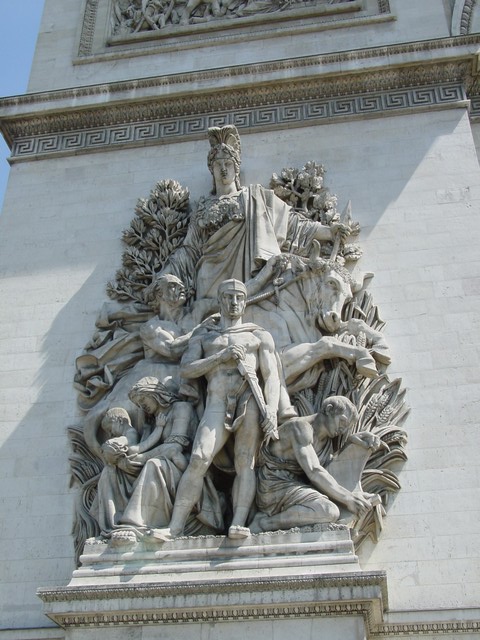

On top of the Arc

Home Vacations France, England, Scotland Previous Page Next Page