
Home Vacations France, England, Scotland Previous Page Next Page
Tuesday. July 25, 2006
Cardiff, Wales to Caerphilly Castle 10.2 miles
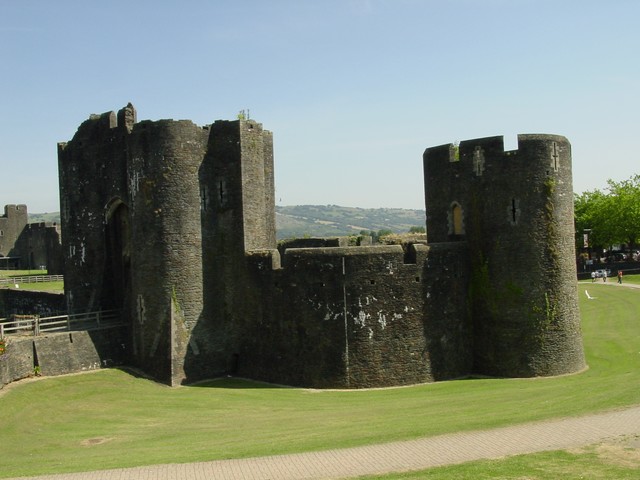
Caerphilly Castle is a Norman castle that dominates the centre of the town
of Caerphilly in south Wales. It is the largest castle in Wales, the second
largest in Britain (second to Windsor castle) and is one of the largest
fortresses in Europe. Built mainly between 1268 and 1271, it is an early example
of a concentric castle and is surrounded by large but fairly shallow artificial
lakes to slow attackers and prevent the undermining of its walls.
Unlike many other Welsh castles, Caerphilly castle was not built by Edward I in
his crack-down on the Welsh lords, but by Gilbert 'the Red' de Clare, a
powerful, redheaded nobleman of Norman descent as a response to a dispute
between him and a nobleman of Welsh origin, Llywelyn who was later a supporter
of Simon de Montfort.
At first the dispute was mediated by Henry III (1216-1272), who sent a Bishop to
take temporary control of the castle until matters were settled. However,
Gilbert soon regained control of the castle.
Gilbert retained control of the castle until the reign of Edward I (1272-1307).
When Llywelyn failed on five occasions to provide services demanded of him by
the King, he was stripped of his lordship and his lands were invaded by Edward.
This removed much of the requirement for the castle, and from then on it was
principally used as a base of operations for the de Clares and later the
Despensers. Towards the end of the 14th century, the family moved to a more
comfortable location and much of the castle was abandoned. Some maintenance was
done by its subsequent owners, Richard Beauchamp (d. 1439), Richard Neville (d.
1471) and Jasper Tudor (d. 1495), probably because of its strategic usefulness,
but this petered out at the end of the 15th century.
The castle gradually fell into disrepair though some maintenance was done on
parts of it, notably the Eastern gate house which was used as a prison. Despite
being mostly untouched by the Civil War of 1642-1648, damage inflicted by the
parliamentary army in 1648 led to one of the most notable features of the
castle, its leaning south-east tower. The castle's condition worsened until the
later part of the 18th century when the first Marquess of Bute began
preservation work. Three generations of Marquesses recorded the details of the
castle, cleared structures built against its walls as leases ended and
eventually undertook painstaking analysis and restoration of the fallen masonry.
Finally it was handed over to the government in 1950; its restoration and
preservation is continued today by Cadw (Welsh Historic Monuments).
Four replica siege engines are on display in
the castle.




Caerphilly to Raglan 32.1 miles

Raglan Castle
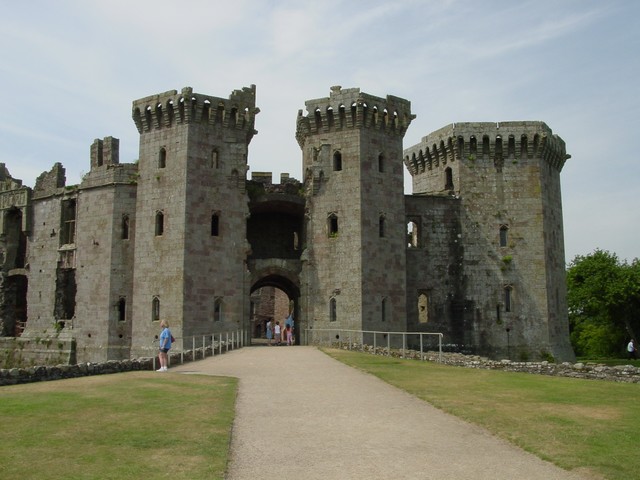
Raglan Castle (sometimes
called Ragland Castle), or in Welsh Castell Rhaglan, is a historically
significant ruined castle located at Raglan, Monmouthshire. It was built in the
Late Middle Ages as a show of wealth rather than to enforce a military presence,
but it later endured one of the longest sieges of the English Civil War.
The castle began construction in 1435 for Sir William ap Thomas, who wanted to
create a statement of his wealth and social aspiration. Upon his death his son,
William Herbert, continued the work. The castle had a stately Great Tower, state
apartments and a grand gatehouse.
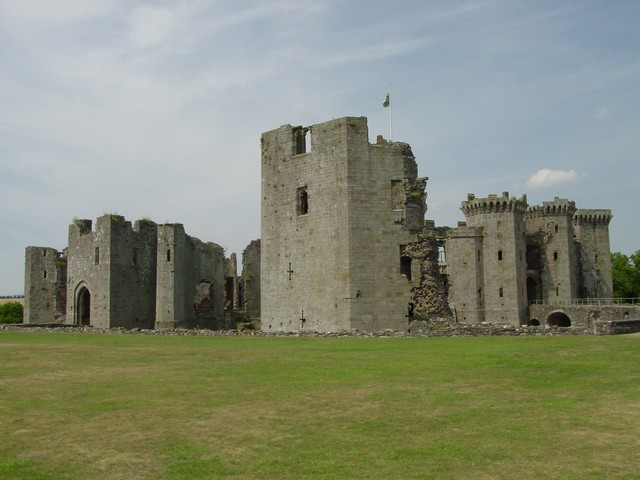
During the English Civil War the castle was held by Royalist supporters of the
king and held out for one of the longest sieges of the war. However, it was
eventually captured by the parliamentarian forces of Oliver Cromwell. To prevent
its further use by the king's supporters, they set about demolishing the Great
Tower. However, this was taking them so long that they abandoned the idea and
instead demolished two of the walls.
The castle that stands today shows the remains of the siege.




to
Raglan to Chepstow 13.8 miles

Chepstow Castle
Chepstow Castle, located
in Chepstow on top of cliffs overlooking the River Wye, is the oldest surviving
stone fortification in Britain. It was built under the instructions of the
Norman lord William fitzOsbern from 1067, and was the southernmost of a chain of
castles built along the English-Welsh border.
The speed with which William the Conqueror committed to the creation of a castle
in Chepstow is testament to its strategic importance. At the time, the kingdoms
in the area were independent of the English crown and the castle in Chepstow
provided a way to suppress the Welsh from attacking Gloucestershire. It
controlled an important crossing point on the River Wye, itself a major artery
of communications to Monmouth and Hereford. The precipitous limestone cliffs
beside the river, and a valley (the Dell) to the landward side, afforded an
excellent defensive location.
The Great Tower was probably completed by about 1090. It was constructed in
stone from the first (as opposed to wood, like most others built at this time),
marking its importance as a defensive stronghold on the border between England
and Wales. Further fortifications were added over the succeeding centuries by
William Marshal and son around 1200, and by Roger Bigod III from the 1270s.
From the 14th century, and in particular the end of the wars between England and
Wales in the early 15th century, its defensive importance declined. From the
16th century, the castle became more designed for occupation as a great house,
though it was to see action again during the English Civil War, when it was held
by the Royalists and besieged in 1645 and 1648. After the war, the castle was
used as a prison. Its occupants included Bishop Jeremy Taylor, and Henry Marten,
one of the commissioners who signed the death warrant of King Charles I, who was
imprisoned here before his death in 1680.
From 1690 onwards it was left to decay, and in the late 18th century its ruins
became, with other sites in the Wye valley, a focus for tourists seeking views
of the "picturesque".
In 1910/11, the castle and adjoining river bed were the site of well-publicised
excavations by Dr Orville Ward, who was attempting to find secret documents to
prove that Shakespeare's plays had in fact been written by Francis Bacon. In
1913, the movie "Ivanhoe", starring King Baggot, was made in the grounds.
Chepstow Castle is open to the public and is now in the care of Cadw.


Chepstow Castle, Monmouthshire, from the River Wye

Chepstow Castle to Nottingham, England 139.7 miles

It was dark by the time we arrived at the
Express By
Holiday Inn
NOTTINGHAM CITY CENTRE. Unfortunately they did not have a parking
area, so we had to park in the casino parking garage across the street.
The record heat wave they are having carried over to the hotel as the room
refused to cool down.
Home Vacations France, England, Scotland Previous Page Next Page